The Widows of Champagne: The Women Who Changed Wine History
Originally published in STROLL Grasslands
This article first appeared in STROLL Grasslands, a publication associated with The N2 Company. It has been lightly adapted for A Well-Poured Life.
The Widows of Champagne
Four women who changed what we drink
Do you ever find yourself going down a rabbit hole of research? You hear or read something that sparks a question, look up one little thing, and suddenly it’s two hours later and you know far more about a completely random subject than you ever intended.
That happened to me when I came across the phrase “the Widows of Champagne.”
Who were these women? Why were there so many widows running Champagne houses? And what did they actually have to do with the bubbly we drink today?
Naturally, I had to know.
As it turns out, some of Champagne’s most important innovations came from women who took control of family businesses after losing their husbands—at times when women running major companies was anything but ordinary. Among the most famous were Barbe-Nicole Clicquot, Jeanne-Alexandrine Pommery, Mathilde-Émilie Perrier and Lily Bollinger.
Their stories include war, risk, changing tastes, a fair amount of ingenuity and, fortunately for the rest of us, plenty of Champagne.
Barbe-Nicole Clicquot: The Grand Dame
Barbe-Nicole Clicquot was only 27 when her husband died in 1805. Rather than allow the family wine business to disappear with him, she took control of it.
And apparently she wasn't particularly interested in playing it safe.
During the Napoleonic Wars, trade with Russia—an important market for Champagne—had been severely restricted. In 1814, as the blockade was ending, Madame Clicquot moved quickly, shipping 10,550 bottles of her celebrated 1811 vintage to St. Petersburg and beating competitors into the Russian market. The wine was a sensation.
But getting people to drink her Champagne wasn't her only contribution.
Champagne undergoes a second fermentation in the bottle, which creates those wonderful bubbles—but also leaves behind dead yeast cells called lees. At the time, removing that sediment efficiently was difficult, which meant Champagne could be cloudy.
In 1816, Madame Clicquot developed the first riddling table, which allowed bottles to be gradually turned and tilted so the sediment collected in the neck and could be removed. Variations of the process are still used today.
Clear Champagne. A rather important development, as it turns out.
Her contemporaries eventually dubbed her La Grande Dame de la Champagne—and nearly two centuries later, the name seems pretty well deserved.
Madame Pommery: Champagne dries out
Several decades later, another widow would help change not how Champagne looked, but how it tasted.
Jeanne-Alexandrine Pommery took control of Pommery & Greno after her husband's death in 1858. At the time, Champagne was generally much sweeter than the styles most of us drink today.
Madame Pommery recognized that tastes—particularly in Britain, an important market—were shifting toward drier wines.
In 1874, the house introduced Pommery Nature, considered the first brut Champagne to achieve commercial success.
Think about that the next time you order a glass of Brut.
One of the most common styles of Champagne today was, at one point, a disruptive new idea.
Mathilde-Émilie Perrier: Why stop at dry?
Then came Mathilde-Émilie Perrier.
When her husband, Eugène Laurent, died in 1887, she took over the Champagne house and combined their surnames, giving us the name Veuve Laurent-Perrier.
And apparently Madame Perrier looked at this trend toward drier Champagne and thought: We can go further.
In 1889, Laurent-Perrier introduced Grand Vin Sans Sucre—literally, wine without sugar—created to appeal to customers who preferred very low-dosage Champagne.
The idea was well ahead of its time.
Laurent-Perrier revived the concept nearly a century later with Ultra Brut, and today Brut Nature—Champagne with no added dosage and less than three grams per liter of residual sugar—is an established category.
If you’re a card-carrying member of the “drier the better” club, you can raise a glass to Madame Perrier. With little to no added sugar, these wines tend to be wonderfully crisp, bright, and unapologetically dry.
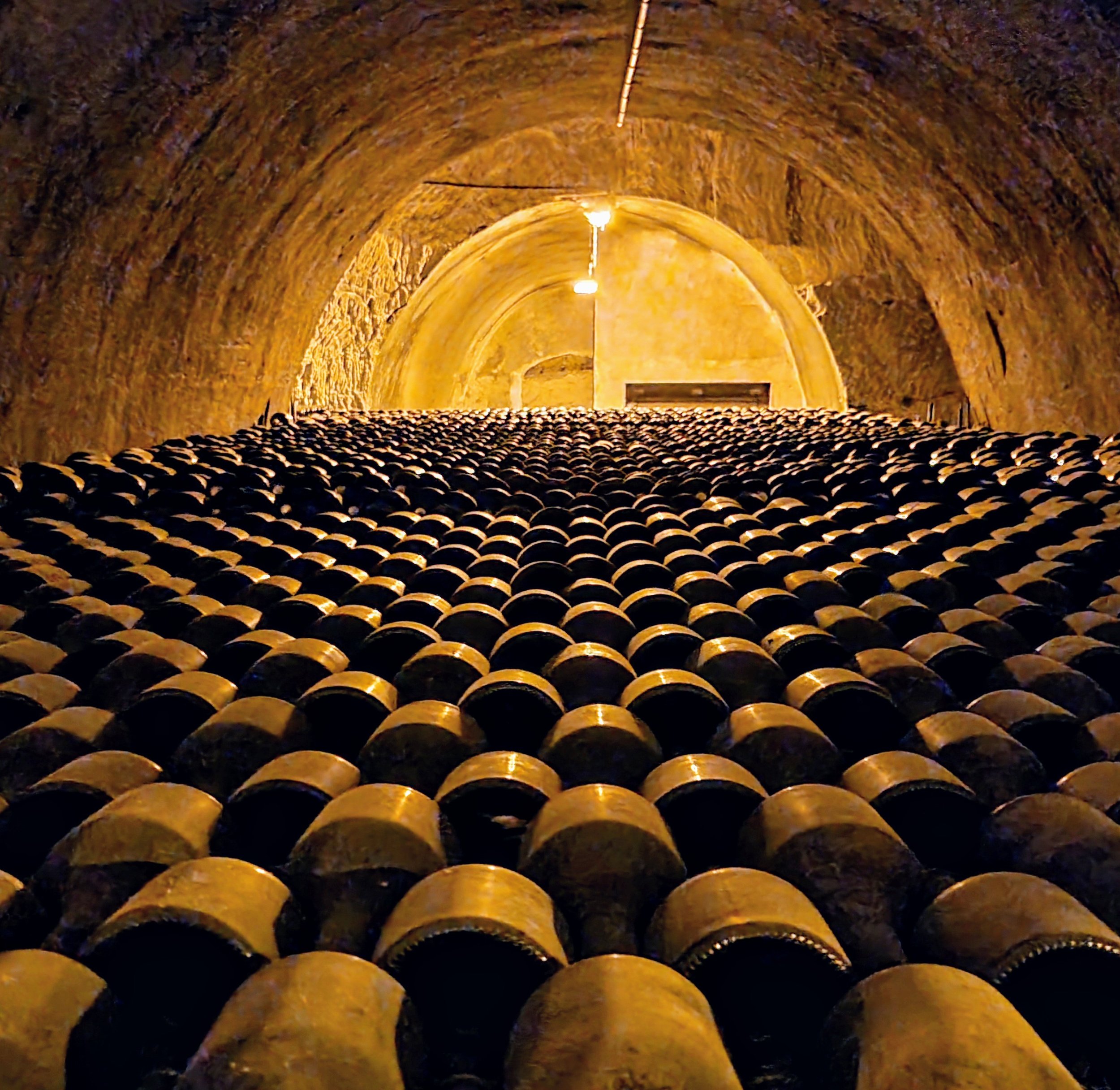
Champagne aging in the cellars of Taittinger in Reims, France. Photo: UNTERMVIERENBERGE-2 / Wikimedia Commons (CC0)
Lily Bollinger: Sometimes the secret ingredient is time
Elisabeth “Lily” Bollinger took over Bollinger after her husband Jacques died in 1941, in the middle of World War II. She would lead the house for decades and become one of Champagne’s great personalities. Elegant, formidable, and famously quick-witted, she was known for bicycling through the vineyards, charming journalists, and speaking about Champagne with a wonderfully dry sense of humor — the sort of woman who made it quite clear that Champagne wasn’t something reserved only for grand occasions.
In other words, she understood something worth remembering: sometimes the occasion is simply that you opened the bottle.
One of her most lasting contributions came from asking what would happen if exceptional vintage Champagne spent much longer aging on its lees before that sediment was finally removed.
The result was Bollinger R.D. — Recently Disgorged.
The first release, the 1952 vintage, debuted in 1967 after years of extended lees aging. The concept allowed Champagne to develop the complexity that comes with long maturation — think more brioche, pie crust, and creaminess— while retaining freshness by being disgorged relatively close to release.
Bollinger still produces R.D. today, and extended aging remains central to the house’s style.
Not a bad legacy.
More than a good story
What struck me most when I first stumbled across the Widows of Champagne wasn't simply that four women were connected to some of Champagne’s most important innovations.
It was when they did it.
These women took over businesses because of loss, often during periods of war or tremendous social upheaval, in an industry—and a world—largely controlled by men. Yet they didn't merely keep their husbands' businesses alive.
They changed them.
Clicquot found a better way to clarify Champagne. Pommery helped move Champagne toward the dry style we recognize today. Perrier pushed that idea even further. Bollinger showed what additional time on the lees could do for an exceptional wine.
The next time someone pops a bottle of Champagne, chances are at least a little of what makes that bottle look or taste the way it does can be traced back to innovations championed by women like these.
Which makes this one research rabbit hole I'm very glad I fell into.
Cheers to the widows. 🥂
Featured image: Madame Clicquot, portrait by Léon Cogniet, c. 1859–1861. Public domain via Wikimedia Commons.
